
My $100 Challenge – Donate To Stop Saying “Umm”​

Ummmso I like kinda have a confession….I’ve given conference keynotes, been on panels, presented in front of classes, and generally feel confident with public speaking. But since starting an experiment to create a YouTube channel, I’ve been surprised by just how many times I say filler transition words (“Um”, “Like”, “So”, “Kinda”).

I developed a plan to remove those words and have more clear speech.

Scroll to the bottom and give me a comment with your most used filler word AND any of your public speaking strategies. Then scroll back up and read the rest, ha 🙂

When I’m recording a 10 minute video, I probably have about 30-45 minutes of footage that I end up editing. And after posting my 7th video on QuinnTalksMoney this year and realizing the unbelievable amount of filler words I use, I thought of a plan.

Donate to charity to stop saying the filler words!

I decided that I would record the videos in one take AND any time I used Um, Like, So, or Kinda, I would donate $1 to a charity. Once I hit $33 I would choose a charity and donate the money. This would force me to slow down, be more intentional with the words I chose and put me in a situation where I would truly know the extent of my “Um” problem.

I would do this three times until I hit $100 to charity. This should take me a while…right?

WRONG!

1st Attempt – I recorded a video on recommendations for online investing platforms. It was a topic I felt confident completing in one take.

While I was recording, I tried to keep track of the Um, Like, So, and Kinda uses.

At the end, I was proud because in my head I had counted 3 and thought to myself, “It’s going to take me awhile to get to $33 at this pace.”

NOT SO FAST!https://www.linkedin.com/embeds/publishingEmbed.html?articleId=7838523517715464332

Let’s just say that I must be really bad at counting too.

As I rewatched the footage, I kept a tally. Within the first minute or so I had already passed 3…

Then it was 10…

15…

20…

25…

30…

THIRTY THREE!!!!

I could not believe it! In the first video, the one I had so much confidence in, I said the filler words 33 times. That was $33 toward a charity (see charities chosen below).

Hitting the $100 mark

7 videos later, I have exceeded the mark! There’s a good chance I even missed some when counting during the editing.

No alt text provided for this image

Here are the stats:

  • Attempt 1 (Investing Apps): $33 for 33 filler words
  • Attempt 2 (Extra Income Ideas): $9 for 9 filler words
  • Attempt 3 (Investing Mistakes): $15 for 15 filler words
  • Attempt 4 (Charlie Munger): $15 for 15 filler words
  • Attempt 5 (GameStop Part 1): $10 for 10 filler words
  • Attempt 6 (GameStop Part 2): $12 for 12 filler words
  • Attempt 7 (GameStop Part 4): $8 for 8 filler words

*Some of these I ended up not being able to do in one-take. I counted the filler words while editing.

Maintaining perfection

It would be great if maintaining perfection was as easy as that, but I know I’ll continue saying filler words every now and then. Although I’ve definitely reduced my filler words, it will take a conscious effort to change this habit.

Practice is the best I can do, and I vow to continue bringing clarity to my content and speaking 🙂

Charities I’ve Chosen

I am overjoyed to have been able to donate $33 to each of these amazing charities:

  • Lunch on Me – After spending the month of December in Los Angeles, I found this incredible organization. They bring nutritious meals to skid row and serve 10,000 people per month. They have an awesome bodega, LaRayia’s Bodega that is an extension of the non-profit. If you are in LA, please go check it out. Buy a kombucha, some sea moss, a crystal, and support/volunteer.
  • Got Green Seattle – Another great org in Seattle that is helping to raise voices and break down the “green ceiling” that keeps low income communities from finding benefits in the green economy. And check out that great website art.
  • Good Cheer Food Bank – This is a local non-profit in my community that runs a food bank and thrift store to help support the community on South Whidbey Island in Washington.

In addition, I’m joining a Toastmasters group to continue learning and growing.

———-

Thanks for getting all the way down here 🙂 I think you’re awesome! If you liked this article, drop me a like or comment!

4 Steps to Make Progress on Side Hustles

I’ve found something interesting this past week. Each action we take in life, each goal, hobby, business we start has the same structure as a startup.

I restarted a side YouTube Channel, QuinnTalksMoney, that I work on during my nights and weekends. By trying to hit 200 subscribers by the end of January, I realized that my strategy should be the same that you’d expect for a high growth Silicon Valley startup.

↓ I’ve detailed the 4 steps below ↓

Tell me what similar experiences have you had that relate to the life of a startup in the comments.

——————————————-

1. Define your niche and solve a problem.

I’ve been lucky enough to spend the last 6 years at TINT. Not only has this experience been the time of my life, but I’ve understand the necessity of defining your market early on, and ensuring that you are solving a problem and bringing value to customers.

This goes for any side hustle that you hope to start. No matter how small or seemingly insignificant it might be.

Spend time figuring out where are able to bring value, and then validate this with people in your network to ensure that you are able to provide what people are expecting.https://www.linkedin.com/embeds/publishingEmbed.html?articleId=9135492551403321720

2. Create a product that brings value

In my case, I’m creating videos and content. They are FAR from being Hollywood production quality (as you can see above), but the content and what I’m saying is my product. If I am not bringing value, then the audience will leave and my “startup” will fail. So the top priority is to bring useful insights via YouTube videos. The studio lighting can come next month!

I’m fully in experimentation mode right now and just having fun while I get into a routine and groove with creating content at nights and on the weekend. The video above I created in 2 hours after getting my invite to Clubhouse App.

This should be similar with your life as well. As a sales person, or a customer success manager, or a chief of staff, if you are not bringing value to the customer, your company, or your executive team, you will likely see less success. Define what challenges exist, and find ways to fill that void and provide a solution.

3. Friends and Family Round! Build loyalty and confidence.

No alt text provided for this image

For almost all startups and businesses, you have to start with a friends and family round. There is a very obvious reason for this. They know you, they trust you, and….they want to see you succeed. Also, they usually willing to put their money and efforts behind you…before you have anything to show for it. They take a risk in you.

Too many times in my life I have tried to do things alone building a side hustle or achieving a goal. Not only does this decrease the likelihood of success, but it wastes valuable time.

Engage your friends and family to get feedback, and give you the confidence and traction you need to have a slightly more legitimate offering.

For my few videos I would ask my wife to leave our house while I filmed because I was so embarrassed about messing up. All I was doing was talking to a camera in an empty room, but it was so difficult (and still is).

After I posted my 10th video, you start to get comfortable speaking into a camera. Step out of your comfort zone a bit and your confidence will continue to grow and snowball.

4. Expand your reach and grow

Once you’ve tapped all your friends and family (and have thoroughly annoyed them!) it’s time to broaden your reach.

I’m not quite at this stage yet, but next steps will include:

  • Expand to other social networks – Every social network has different content forms. I’ll find ways to bring value on other platforms like Instagram, Facebook, and maybe even TikTok.
  • Collaborations – Find other creators that are in a complimentary niche. Collaborate on content to tap into each other’s networks.
  • Review analytics and make adjustments – Don’t worry about this too much before Step 4. Get in your groove, put content out there, and then review analytics to find trends and improvement areas.
No alt text provided for this image

Pivot and Iterate

Yes, this will be inevitable. As we get started with anything there are a million pieces of information that we just cannot know right now. So always be open to adjusting your model to find what works.

If you make 10 pitches to a client and no one wants to learn more about your product, well it might be time to change your script. If I make 50 videos and the only people watching them are my wife and mother, well then I might need to adjust my content to have a wider appeal 😛

————————————–

My main takeaway from this short journey so far has been that enjoying the process with patience is essential. There is absolutely NO WAY that I will be able to hit my goal of 100 videos posted to my channel in 2021 if I am burning myself out, talking about topics that bore me, or focusing too much on view, likes, etc. etc.

Yes, I ask people to like and comment in my videos, but that is honestly the least of my worries. My biggest concern is that I’ll sit in my cold garage into the dead of night creating videos that I don’t care about, and that my audience (tiny right now) has no interest in.

So let’s have fun and build our life goal startups!

And because Step 3 is important…here’s the link to my YouTube channel, QuinnTalksMoney, so you can subscribe haha!

I spend 10 hours/day learning to code

My life adventures have included mountain climbing, world travel, and a half ironman. I’m only 2 weeks into my latest adventure and it is far harder than all of those combined.

My latest adventure includes sitting in a chair for hours on end, staring into a screen of gibberish until you’re about to fall asleep, and going through a roller coaster of thoughts ranging from “I understand this perfectly,” to five minutes later, “I know absolutely nothing about anything in the world,” to “What is a brain? Why don’t I have one?”

This adventure is a 15 week intensive software engineering program at Flatiron School. I’m doing this along with continuing work at TINT/Filestack. My days are jam packed (typically starting about 5am) and exhausting, but I’ve actually been able to have higher output focusing on the most important tasks that allow me to be successful in each endeavor.

No alt text provided for this image

I chose to go to coding school for a few reasons:

  1. My experiences are all over the place: hotels, startups, marketing, digital signage, finance, business development. One glaring area I found missing was technology. I have a high level understanding of technical concepts, but applying those concepts into useful outputs was a gap I wanted to fill. 
  2. TINT was acquired in September. I was a bit burnt out from 4 years at a startup and needed to make sure I was giving myself the best shot at continued happiness and growth. I’m grateful for our new parent company’s willingness to allow me learn a new skillset while still working.
  3. I like building things. I’ve always loved putting things together without instructions. I’ve tried this method of “no instructions” with coding, but have been unsuccessful. I needed an in-person, full-time bootcamp to immerse myself and allow myself to suffer through hours on end of brute forcing my way to solutions.

Why Flatiron School?

I chose Flatiron School because it had a great reputation, but more importantly, I chose this over some other programs because Flatiron made me realize that I wasn’t just a client, I was a part of a family.

This was a main decision factor because of my time at TINT and the culture that our three cofounders Tim, Nik, and Ryo created. I am proud to have been a part of such a special culture and honored that I was given the opportunity to be a part of it seeing the many highs and a few lows of the company through it’s acquisition. Three similarities I see between TINT and Flatiron School are:

  • Feel cared for
  • Transparency
  • Shared enthusiasm

It is hard to put into words how positively my life was affected at TINT and I owe so much of who I am today to that experience. If my experience becoming a software engineer at Flatiron School is 10% as good, it will be a huge success. So far, the culture and experience have not disappointed.

No alt text provided for this image

When I told some people that I was planning to go to coding school I was mostly met with confusion by people outside of my family. People didn’t think I was a coder and couldn’t see why I didn’t put my time to other tasks. A few people recommended I rethink my decision. 

However, for the people that knew me most and know my ambitions and interests, it was a predictable step. Up until 5 years ago, I spent a lot of my academic life enjoying math, physics, and STEM. I originally wanted to be an engineer before randomly finding a magazine that talked about a college in Switzerland, realizing that school only offered Hotel Management as a major, and then proceeding to research and fall in love with the hospitality industry. “Bye for now STEM”.

No alt text provided for this image

Now that I’ve had my taste of hospitality and a few other experiences (hey Giving Bag), worked around the world at amazing hotels, and enjoyed every second of my current career, I’m looking for my next challenge and growth area. Software engineering is that adventure!

What’s next?

Not a clue! There are a lot of options that I’m continuing to explore. Some include starting my own company, going back to previous roles with my new skills, becoming a Chief of Staff, being a full time software engineer, or most likely a combination of all those! 

My mind is open to possibilities. I am a naturally curious and intellectually hungry individual. I anticipate that the skills I learn will continue to excite me and continue to open up new areas that I’ll want to explore.

loop do

puts “Keep on smiling”

end

I read 83 books in 2 years. Here are the results.

I never planned to start reading books at such a pace. There were a few unplanned things that happened that helped get this going.

I lived in NYC (moved out in June) where you sit on a subway for 1-2 hours per day. Some people sit there on their phones playing Candy Crush.  I didn’t want to be idle and found myself finishing 1-2 books per week.

My brother bought me a Kindle. This gave instant access to thousands of books. They were either inexpensive, or free (public library’s have Kindle books). The Kindle let me use small pockets of time that we typically fill with pointless scrolling and staring. With the Kindle, I could read for the 5 minutes I stood in the grocery line (or 30 minutes at Trader Joe’s).

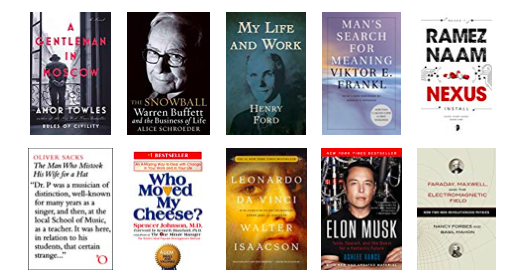
TINT had a book club where I read Gentleman in Moscow. This got me back into Fiction and History which I had previously put off as lacking value for my immediate life.

This is my reflection on the books I read:

I wanted to read Computer Science, Rocket Science, Neuroscience, Science Fiction – yes lots of science – Biographies, Self-improvement, History, and books on many other topics. 

So my journey with books began…

Top 5 Books

  • Gentleman in Moscow
  • Nexus Trilogy
  • Man’s Search for Meaning
  • My Life and Work – Henry Ford Biography
  • The Snowball: Warren Buffett and the Business of Life

Favorite Biographies

  • Benjamin Franklin
  • Elon Musk
  • Henry Ford
  • Warren Buffet

Favorite Self-Help Books

  • Chop Wood and Carry Water
  • Man’s Search for Meaning
  • Who Moved my Cheese
  • 4 Hour Work Week

Most Tedious Book to Read

  • Howard Hughes: His Life and Madness

Favorite New Genre

  • Science Fiction

Hardest Genre to Find Decent Books

  • Self-improvement

Surprisingly Decent Book

  • The Man Who Mistook His Wife for a Hat

Most Unexpectedly Practical Book

  • My Life and Work – Autobiography of Henry Ford. This made me realize so much about Tesla’s potential.

Most Interesting Topic to Read About

  • Body Machine Interfaces- Combining computers into humans. We do it already with all types of technology, but there are more innovations to come.

Top Excerpts That Taught Me The Most

“It became, at least in retrospect, humorous as well as revealing of Leonardo’s unwillingness to fulfill commissions that bored him.” ~Leonardo da Vinci by Walter Isaacson

“Everything can be taken from a man but one thing: the last of the human freedoms—to choose one’s attitude in any given set of circumstances, to choose one’s own way.” ~Man’s Search for Meaning by Viktor E. Frankl

“He had to admit that the biggest inhibitor to change lies within yourself, and that nothing gets better until you change.” Who Moved My Cheese by Spencer Johnson and Ken Blanchard.

“What Musk has developed that so many of the entrepreneurs in Silicon Valley lack is a meaningful worldview.” Elon Musk: Tesla, SpaceX, and the Quest for a Fantastic Future by Ashlee Vance.

“What opened up the world for him, were the books themselves: picture books, adventure stories, novels, books on philosophy, and, most of all, anything about the physical world and men’s attempts to find out how it worked. He became a seeker of truth…supplement reading with the ‘living discourse of a wise, learned and well-qualified teacher.'” ~Faraday, Maxwell, and the Electromagnetic Field by Nancy Forbes and Basil Mahon.

The Snowball: Warren Buffett and the Business of Life – “But birds in the bush were expensive because interest rates were low. Fewer people wanted cash—the bird in the hand—at such low rates. So investors were paying unheard-of prices for those birds in the bush.”

“It’s far better to buy a wonderful company at a fair price than a fair company at a wonderful price.”

My Life and Work by Henry Ford – “Almost any one can think up an idea. The thing that counts is developing it into a practical product.”

“No work with interest is ever hard.”

“Life is not a battle except with our own tendency to sag with the downpull of ‘getting settled.'”

“Time spent in fighting competition is wasted; it had better be spent in doing the work.”

“They listened to the 5 percent, the special customers who could say what they wanted, and forgot all about the 95 percent who just bought without making any fuss.”

———-

As I continue to read more books, I’ve learned more about my passions, hopes, and dreams. I am more motivated than ever to find ways to change my life in a way that will bring me closer to my passions. I’ve learned new topics that informed positive personal, professional, and investment decisions.

What other books should I be reading?

———-

Full List of Books Read

  • 1984
  • A Gentleman in Moscow (x2)
  • Abraham Lincoln: A Concise History of the Man Who Transformed the World
  • An American Life: Benjamin Franklin
  • Anti-Fragile
  • Apex (The Nexus Trilogy)
  • Beautiful Boy
  • Benito Mussolini: A Short History
  • Bitcoin for Dummies
  • Boomerang
  • Brave New World
  • Chop Wood and Carry Water
  • Congress and the shaping of the Middle East
  • Crux (The Nexus Trilogy)
  • Cryptoassets
  • Customer Success
  • David and Goliath
  • Dead on Arrival
  • Devil Take the Hindmost
  • Elon Musk and the Quest for a Fantastic Future
  • Faraday, Maxwell, and the Electromagnetic Field: How Two Men Revolutionized Physics
  • Flash Boys
  • George Washington: The American Presidents Series
  • How Money Got Free
  • Howard Hughes: His Life and Madness
  • Inheritance
  • Leonardo da Vinci
  • Liar’s Poker
  • Life, the universe, and everything
  • Made to Stick
  • Making Humans Multi-Planetary (Elon Musk)
  • Man’s Search for Meaning
  • Manifesting Change
  • Moneyball
  • More than human
  • My Life and Work
  • Neuralink and the Brain’s Magical Future
  • Nexus (The Nexus Trilogy)
  • Only the Paranoid Survive
  • Origin
  • Out of My Later Years: The Scientist, Philosopher, and Man Portrayed Through His Own Words
  • Physics of the Future
  • Quantum Reality
  • Robber Barons
  • Rose Water
  • Rules of Civility
  • Sentient Machines
  • Snowball: Warren Buffett
  • Soft Wired
  • Stress Test
  • TED TALKS: The Official Guide to Public Speaking
  • The Adventures of Huckleberry Finn
  • The Art of Invisibility
  • The Art of War
  • The Big Short
  • The Chip
  • The Destiny Forumula
  • The Fall of Heaven
  • The Fear Index
  • The Four Hour Workweek
  • The Future of the Mind
  • The Hitchhiker’s Guide to the Galaxy
  • The Man Who Mistook His Wife for a Hat
  • The Minimalist Mindset
  • The One
  • The Outliers
  • The Restaurant at the End of the Universe
  • The Third Door
  • The Tipping Point
  • The Undoing Project: A friendship that changed our minds
  • The Wizard of Menlo Park
  • Theodore Roosevelt: A Life From Beginning to End
  • Things I wish I’d known before we got married
  • Thinking, Fast and Slow
  • Vietnam War: A Short History
  • What the Dog Saw
  • When Breath Becomes Air
  • When to Jump
  • Who Moved My Cheese?
  • Will China Dominate the 21st Century?
  • Winston Churchill: A Short History
  • Zero to One

Reuse Social Content – Be More than a Logo.

Every day on Facebook, 2.5 billion pieces of content are created. Is all that peer/customer content being used? Are brands finding ways to reuse social content and user generated content? The sad thing is, they are usually not. 

Why is it so hard to come up with a successful marketing strategy? How can you successfully market when new channels and ad products are created every week?

I get asked these questions all the time. They are valid questions too. You just don’t have the time to create lots of content.

In many situations, the reality is that your customers are creating better and more content than you could ever do. I see so many marketers that understand how to manage a social strategy, but they are missing out on huge amounts of value by neglecting their customers social content, or user generated content. 

There are just more customers than there will ever be members on your team.

1. Time Value of Social Content

The longer you wait to reuse social content from your customers, the more value you lose.

Who remembers the Time Value of Money lessons from high school? If you don’t save money today, you miss out on the chance to earn interest. It’s the same with content marketing; if you let hundreds or thousands of customer created social posts go to waste each month, your “content bank account” is dry and “brand image account” can’t grow.

Brands are pushing expensive branded content in the hope that customers will latch on. 

Hope is not a strategy.

UGC posts for brands earn almost 7x more engagement than brand generated posts (Campaign Live).  

That’s data, not hope.

Humans want to talk to humans and have natural social engagement

2. A big social media audience means nothing

If you are not successfully using the fans and followers you have, it is pretty much the same thing as having 0. Take a look at Marriott’s Facebook page. With 2.5 million likes, you would expect that their social media engagement rate is relatively high as well. But when you look at their posts, they average around 100 likes. That’s an engagement rate of 0.004%.  

Many marketers and agencies think that to be successful with crowdsourced marketing campaigns, you need 1000s of posts. But you really only need 10-20 pieces of great social content to find success.

A website visitor or pedestrian looking at digital billboards isn’t going to stay there forever. So you need to pick the most effective photos to do the job. I did a quick search on TINT’s Suggested Post engine and within 10 seconds I found these gems from Marriott guests. #gold #timesaver

These are the types of photos that consumers want to see. If Marriott requested the User Rights to these photos and were able to reuse social content on their marketing channels, they would very likely have a better chance to build authentic relationships with customers.

Travelers make purchase decisions many times on visual content and customer testimonials. If those two things don’t relate to social media, I’m not sure what does. Let your customers loose and be surprised at the trustworthy and authentic content they will create.

3. Tesla vs. Ford. The “cool uncle” vs. the “boring grandpa”.

Tesla delivered about 76,000 cars in 2016. Ford sold 2.6 million. But even with far fewer deliveries, “Tesla was the number-one most mentioned US car manufacturer [on social].” (Zignal Labs). Why does Tesla have a powerful cult following when Ford’s image is stagnant and dying?

Tesla is storytelling about life, rather than a product. They never market about price and miles per gallon. Tesla markets a lifestyle and an experience. How many brands can get people to positively talk about them on social media without even having purchased their product?

The meaning of Tesla’s brand goes beyond cars. Plenty of news organizations, when reporting on Tesla, say something like, “Tesla is now the largest car company in terms of market cap in the world.” But that’s wrong. Tesla isn’t a car company. Tesla is a way of life for people that want to make the world a better place through innovations in energy and cars. 

Authenticity and passion are not only good for products and services, but for changing the society around us. A brand can only work so hard to create consistent content for social. If you reuse social content from your trusted audience, your brand image will thank you.

BONUS! #4 – So, how do you even start to reuse social content? Find, Ask, Receive.

  1. Find a post you like and that you think will resonate with your audience.
  2. Send them a message asking for permission to use their post and include a link to your Terms of Service.
  3. Provide a clear way for them to respond. You can say something like, “Respond #Yes to agree.”
  4. When they reply #yes (TINT’s data shows that 2 out of 3 respond with a #yes) you can now use that content.
  5. Now you can start to reuse social content that is authentic and relevant to your audience.

Consumers will happily look at ads, but they will get immediately turned off if they think your ad is untrustworthy or irrelevant. As more marketing channels pop up, the only way for marketers and agencies to expand creativity in a scalable way is to use authentic content from real people. 

For more info on how to automate that process and how to use the content, check out the User Generated Content Page.

China’s censorship helped prove earned media’s effectiveness

This post is a response based on the study of Seiler, Yao, Wenbo where they studied the effects of viewership and ratings of TV shows in China after a government shutdown of a social network similar to Twitter, called Sina Weibo.

In this quick post, I’ll explore how this shutdown can help us see the effectiveness of word of mouth and Earned Media on a business’s primary functions and demand.

Study Overview:

Due to political unrest in 2012, the Chinese government temporarily censored the popular Chinese microblogging site Sina Weibo (similar to Twitter) for three days.  This unique opportunity allowed the researchers to get a rare glimpse into the effect of earned media, social media, and word of mouth due to the censorship for a period of time and the ability to compare similar time periods where there was no censorship.

This particular study looked at how certain TV programs viewership and ratings were affected with this censorship.  Although this post is brief and a general overview of the entire study (listed below), this is a starter to understanding the relationship of social media and its ability to convert.

It is important to note that, “The nature of the censorship… primarily affected user-generated content, namely, earned media. Specifically, the censorship did not block Sina Weibo entirely, but only disabled the commenting function.”

Main Findings:

The overall summary shows that the censorship of earned media, and therefore reduction in earned media content over that time period, led to a reduction in TV viewership.  When a brand is cut off from their interaction with Millennials, a group relying heavily on social media, it can cause a void in the spread of brand awareness and engagement.

Because of the nature of the censorship, the researchers could compare the statistics and TV ratings to the use of Twitter in Hong Kong (which was not censored) and the use of Sina Weibo in rural and mainland areas where Sina Weibo did not have as much penetration (Seiler, 2015).

The actual findings show how the ROI of Earned Media and UGC cannot be ignored.  The TV ratings in areas with censorship immediately experienced a 3% drop in ratings whereas Hong Kong (where they used Twitter) and rural areas (that did not have considerable Sina Weibo penetration or usage) did not experience a change in viewership (Seiler, 2015).

90% of consumers trust content from REAL PEOPLE before they trust a brand’s content. ~SAP

This glimpse into the effect of User Generated Content and word of mouth marketing tells marketers about the growing effect of authentic interaction on social media and for advertising.

Where do we go from here?

We can therefore see based on these findings that the use of earned media before a campaign or an event, and in this case watching a TV show, can have a positive effect on engagement and participation.  Brands should put a focus on encouraging participation to increase those engaging online and creating earned media and user generated content.

The whole study can be found here.

Send me a message if you have other statistics like this. Would love to see how your brand finds value in Earned Media.

Liked this one? Here are two others on Earned Media and The Problem with Virality. Please share and comment and like 🙂

Social Media Infatuation. The problem with viral campaigns

“An audience that participates is an audience that connects to a brand’s underlying message.” ~QC

Social media advertising budgets continue to increase each year, but some marketers are beginning to forget about the benefits of an actionable social media strategy (Ashley, 2014). 

I want to talk about the obsession with viral campaigns and their negative affect on a long term marketing strategy.  And then I’ll try to tell you how to combat the infatuation.

At TINT, we call it Social Media Infatuation; an extremely quick obsession with a brand followed by an extremely quick consumer/brand break-up. This results in hills and valleys of engagement with consumers never fully understanding the message they are told.

Viral campaigns effectively get a brand’s name out in the open, but it can be detrimental when it fails to market the story the brand cares about. Some marketers believe that once you have the fans, then you can adjust the message, but when your message is being shared by millions of people, controlling it can be even more difficult than when your fans are in the 1000s.

A long-term strategy to cure Social Media Infatuation

A solid social media strategy doesn’t just rely on earned media or owned media. There needs to be a balance between a brand pushing content and a brand incentivizing their audience to create brand specific content. Proctor and Gamble did this flawlessly with their “Thank You Mom” campaign (Ashley, 2014). 

The brand asked their consumers to share pieces of User Generated Content on social media about their mothers’ role in their athletic endeavors. P&G’s marketing team then captured this UGC and requested the rights to use certain pieces. From that UGC, the brand created commercials and other marketing collateral using their audience’s targeted, relevant, and relatable content (Ashley, 2014).

“We see how strong moms are in every facet of their lives, and how their children draw on that strength as they grow. Through our campaign, we invite everyone to join us in saying, “Thank you” to mums for the role they play in raising strong children.” Marc Pritchard, P&G Global Brand Officer

Success with a content marketing strategy and social media strategy lies in the engagement type of your audience. 

There are two main types within social media: passive engagement and psychological engagement. Passive engagement might be a Like on your Facebook page without any engagement, whereas psychological engagement focuses on the fact that a customer will have you on their mind at multiple touch points and will be willing to share their thoughts on the brand in the future. 

“Psychological engagement is important because consumers are not passive recipients of information; they are participants.” ~Christy Ashley, Marketing and Psychology expert

As Christy Ashley states in Creative Strategies in Social Media Marketing, “Psychological engagement is important because consumers are not passive recipients of information; they are participants” (Ashley, 2014). An audience that participates is an audience that connects to a brand’s underlying message. Fail to live up to the brand image you market and your audience will lose interest.

Your marketing strategy and brand image suffers when:

  1. The conversation only goes on way (i.e. A brand asks for recognition – “use our hashtag” – from consumers, but doesn’t reciprocate an interest in their audience
  2. The brand fails to live up to the image they’ve created.
  3. The brand strays from the image that appeals to the identities of their audience.

The reason that brands should focus on their customers as the characters in their brand story is due to the Self-Expansion Theory.

Self-expansion theory suggests consumers communicate with and about brands due to overlapping identities and parasocial relationships with the brands. Brands can suffer if consumers feel the relationship is one-sided or the brand does something that is not consistent with the consumer’s identity (Huang & Mitchell, 2014)

Easy steps to start a long-term marketing strategy

There are so many mediums with which to interact with a brand audience, that many times marketers do not know how or when to judge the effectiveness of branded content or social media marketing. A study of 1100 brands showed that marketers were guessing on their strategies, with no backing from data, and few results to show (Sheehan, 2009).

At TINT we’ve created 3 easy steps to consider to increase accuracy with your strategy:

1 – Create a 2 way street of communication.  

If you ask a customer to interact with you, interact back. Don’t expect a customer to understand your brand if you aren’t willing to understand why your customers are talking about you. The engagement should focus on interactions rather than transactions, as this will allow the audience to identify with the brand image (Ashley, 2014).

2 – Make the customers the characters in your brand story.

As a marketer, you get to create the overall brand image, but your customers are the ones that reinforce it. You can learn from your customers as they create UGC to understand where they might be moving away from the brand image. At this point, you can find ways to adjust the customer’s perspective, or adjust the slowly brand image to fit with the customers.

3 – Consistency of your brand image is key

A brand doesn’t need to create a Hollywood style video before they can post it online. Keep the content accurate and relevant to your brand image. The more you change your image, the more alienated and confused your audience becomes. You should be posting the same amount every day on each channel, and each piece of content should relate to the brand story. Quality over Quantity doesn’t really work here. It’s more Consistency over Quantity or Quality.

——-

You don’t have to be an expert to craft a good strategy. But it takes more than an idea to find long term success. Get out there, start testing different ideas but keep it all consistent with your brand story. YOU CAN DO IT!

Let me know if I can help.

The Earned Media Economy is here. And your brand is missing out.

In 1970 consumers were hit with 500 advertisements per day. In 2017, that number is expected to hit at least 5,000 per day (New York Times). 

Bombardment with branded content causes consumers to block out brand messages in search for more authentic content. Over 92% of consumers trust recommendations from peers and other real people compared to branded content (Neilsen Global).  

In a “world of stuff”, how can a brand stay relevant without alienating the audience?

Welcome to the Earned Media Economy

Most marketing teams still haven’t entered the Earned Media Economy. Today the marketing landscape requires brands to put a greater emphasis on distributing earned media and user generated content in creative ways. Branded content still holds tremendous value but an intimate understanding of your audience, their needs, and how to influence them lies in the treasure trove of Earned Media.

Control the brand message and let the Earned Media Economy take over.

Think of earned media as your customers working as your marketing force. They are your brand advocates, spreading your products, stories, and images across an ever-growing set of digital channels.

Now, with the Internet at your hands, word of mouth marketing has become Expedited Distributed Voice Marketing (EDVM).

EDVM involves getting consumers to consistently talk about your brand on numerous channels in real time. Now with just an internet connection consumers can share videos, blogs, articles, testimonials, pictures, and 140 character snippets to anyone in the world, in literally a matter of seconds. 

It’s insanely fast, the channels are free and open, and consumers’ voices can be amplified faster and louder than a brand’s.

Brands are authors, consumers are storytellers

As a marketer, think of the Earned Media Economy as a parent dropping off a child at college. You want to be there to make sure they don’t fail, but you just have to let go (I’m not a parent so I’m playing off what I hear!) You have to be the guide, but not the hand holder.

In 2017, this holds true for marketers. You cannot be the dictator of every piece of content. A brand’s job in the Earned Media Economy is to guide the voice of the audience. Provide the base for the brand story and allow your audience to act as the characters in your brand story.

Marketing is no longer brand controlled but consumer controlled. 

"“A customer-oriented mindset stemming from deep social
interaction allows a company to identify and meet customer
needs in the marketplace, generating superior profits.”

~Wetpaint and Altimeter

What can Earned Media and UGC do for you?

Overall, a solid earned media strategy can affect sales, time on site, customer satisfaction, brand loyalty, clicks, and the list goes on and on. 

The hospitality industry is one of my favorite industries.  Not only have I worked at hotels and restaurants, but also the hospitality industry relies on earned media more than most other industries. Mainly because customer testimonials and referrals are a big driver in business, with travelers looking for customer recommendations before trusting a brand.

After implementing a UGC hub on their website Meritus Hotels saw a 93% increase in Time on Site and Click-throughs compared to a corporate image gallery. With more people engaged on their website they are able to convert more leads and direct more visitors to relevant branded content. This could be your brand, but you might be missing the opportunity.

Why Earned Media creates a longer impression

We have discovered that creating a long-term strategy involving your audience and customers can positively affect results and metrics.

A study by Trusov, Bucklin, and Pauwels found that WOM and earned media affect an audience for much longer than traditional media. Specifically, there was “an increase in Word of Mouth to impact [a conversion] for three weeks while traditional marketing effects for three to seven days.”

This shows that UGC and earned media content can bring more conversions (purchases, signups, likes, store visits) with less effort due to the longer life span of that content compared to generic branded content. It won’t just happen automatically, but as a brand begins to aggregate and analyze their UGC and earned media, they can follow trends to improve results.

The Earned Media Economy is here…now stop waiting and take action.

Don’t be the brand that acts last. It’s time to jump on the trend and craft a brand story with which your audience relates. Bring your customers into your brand story and allow them to be the characters through earned media and UGC creation. You’ll create deeper relationships and drive more actions that positively affect your brand.

My goal is to help brands improve their digital marketing strategies through knowledge sharing. Reach out with any questions or ideas. 

Please share if you enjoyed and think others will enjoy too.

Why the new generations should control your hotel’s marketing

Last week I published Part 1 of the Social Media + Hotels series.  This week we are focusing on the word that everyone keeps bringing up…Millennials.

A couple years ago it was easy for a hotel to stand out on social media and “woo” Millennials with some creative social posts.  But as more and more companies are getting in on the action, simply pushing photos and branded content at target markets becomes detrimental.

Marriott in-room screens

With more options for a guest to choose from on social media, it is simple to block the brands that appear unauthentic and lack relevancy.  Millennials WANT to create content.  They are creators more than any other generation in history.  Why waste time creating a lot of content when your guests have already created better content for you to utilize?

Brands, please.…If you want to develop successful digital content strategies, campaigns, and sustainability, you need to understand the DNA of creator and community engagement. It’s imperative.

~The Digital Social Contract

Understand this, the #1 goal in your marketing strategy is to create relationships, not to create content.  Many hospitality brands are thinking too short-termed about social.  Viral videos and having one famous person posting about you are worthless in the long-run.  I call that “social infatuation.”  You’re obsessed with a brand or celebrity for a second and then you forget about it, because the brand failed to recognize a fan needs nurturing.

To really capture new guests and retain current guests, you need to develop that relationship and create a purpose.

Atura Hotels website guest social hub

Sounds easy, so what’s the problem?  The problem lies in the fact that the purpose is often forgotten or misconstrued.   Many brands mistakenly believe that the main goal is to get people to post about you.  But that’s where their social strategies fall short.  The correct priority is to get your guests to see that as a brand, you care about them.

Social media gives you an extremely valuable opportunity; to make communication a two way street.  Too often I see companies say, “Post with our hashtag, post with our hashtag, post with our hashtag”…but they don’t say anything else.  That’s the definition of one-way communication.

Offering an incentive like, “Post with our hashtag and win a trip to San Francisco,” is a step in the right direction but still not as powerful as it could be.

To really be successful with Millennial marketing, hotels need to respond and demonstrate appreciation for the audience and fans who have invested a social media post talking about YOU.  Failing to reciprocate for your fans is like failing to say thank you when someone holds the door open — after you’ve asked them to hold the door.

Don’t waste an opportunity to create that relationship with guests.  They want your love and affection.  A simple, “Hey Quinn, great picture!” goes a long way.  And if you got 10,000 posts and can’t respond to everyone, how about displaying that content on your website or lobby screens for people to see, and then letting them know.

“Thanks to everyone that posted for us.  We got SOOO many posts that we can’t thank you all individually, but check out your pictures on our website and lobby screens to show our appreciation.”

These extra demonstrations of respect for your guests are what will allow your hotel to stand out among the competition.  It’s too common and extremely frustrating to see a poster with just a hashtag and nothing else.  Show a purpose, and be the reason that the guest wants to post.

47 percent of millennials are influenced in their purchases by social media, compared to 19 percent for all other age groups.

~Deloitte

As travel among younger generations continues to grow, hospitality brands need to focus on being a part a of story rather than being part of a social media network.

Sofitel Dubai The Palm Resort & Spa – In Room Social Channel

Old content is a killer.  Fresh content can drive more conversions, higher awareness, and increased acceptance.  Outdated display platforms make you wait extended periods of time to update your created content loop.  What good is a five week lag time in an age when we are trying to shoot a pod through a tube at 700 mph to transport people from LA to San Francisco in 30 minutes. Five weeks is an eternity!  

It’s like grandma always said, “If your social media content isn’t always fresh and relevant, how will you build a real relationship with your guests?” (she actually probably didn’t say this).

Nobody wants “social infatuation”.  Why waste your time with content that doesn’t excite and drive long-term relationships?  The technology is there, and hotels are seeing the power.  Is your hotel a part of the change?

Subscribe to the blog to get notified of new posts!

Social Media & Hotels | Creating a UGC Highway

I wrote a hospitality trends article back in 2014 about the increasing applications of social media in the hospitality industry.  It’s already out of date.  And it seems with the speed that consumer habits are changing, by the time you’re done reading this updated version, it will be outdated as well.

But I’ll give it a shot.

”   They say that 52% of travelers change their original travel plans due to Social Media.  “

Before coming to TINT, my background was in hospitality.  I graduated from the School of Hotel Administration at Cornell and worked at hotels and restaurants in Dallas, Philadelphia, Costa Rica, and Nicaragua.  I did just about every job, including a stint as an Omelet Artist at Four Seasons Philadelphia.

Now that I work at a social media technology company, TINT, I have an interesting view of tech trends within the hospitality industry before they actually take off.

Over the next three weeks I’ll take you through three big trends with social media, how they relate to the hospitality industry, and how hotel managers can make that statistic work in their favor.

Part 1: Creating a social media highway

This year, it’s about storytelling.  Social media alone isn’t enough for hospitality companies to get by.  Hotels need to create authentic, visual, and interactive experiences for guests that facilitate a deeper connection with their brand.  

Viewing a hotel’s social media posts used to be siloed within each social network. In the past, there was a trade-off. Hotels wanted likes and follows but they also wanted reservations. To get likes and follows, hotels would have to steer guests away from the reservation page to the hotel’s content on external social sites like Facebook or Pinterest. Not very productive for the Hotel or the user.

That’s all changed.  Hotels now have the ability to place specific social posts within their website and on displays in their lobbies to create an engaging experience for a guest from reservation to check-in to check-out. Hotels can choose to display content created by their social media team or posts from guests. We’ve seen the latter be particularly effective for telling a compelling story. We call this second category “User Generated Content.

Why User Generated Content?

Why does User Generated Content matter?  Because 77% of hotel guests read reviews before booking their hotel. Your guests’ social media posts are actually small but trusted reviews.  By harnessing those posts, you can strategically place relevant “reviews” in front of guests while they are deciding whether or not to book.

Social reviews have a distinct advantage over other types of reviews — in addition to creating compelling content for a Hotel website or booking engine, these reviews reach the personal audience of each guest that posts about their stay. Given that social media posts or pins from friends is reported to influence 59% of global purchasing decisions, these social reviews are extremely valuable.

 The

Broadly, 46% of consumers consult social media when making a purchasing decision. In the past guests had to go back to a hotel’s social media page and sift through all types of posts to find that information.  Now the hotel can make that process easier by displaying the relevant content when and where it matters most to the guest.

With technology platforms that aggregate all types of media content, brands like Loews, Marriott, Six Senses, and Hilton are working to take guests seamlessly from social media content on the web to social media content on-property. Seeing posts from their vacation in the lobby of the hotel has turned out to be a fun experience for guests — one that encourages them to not only share more photos, but to tag the hotel in all the great experiences of their vacation. Incorporating social media into the hotel experience that can make the guest experience more fun, the hotel’s social media presence more robust, and ultimately, increase reservations.

The social media highway is not just about keeping web visitors on a branded site. It’s about seamlessly including social media in the hotel experience throughout a guest’s entire stay. 

Hotels are getting creative with what they display on Lobby screens. From announcements, and social media posts to other digital content like videos, weather, and webpages.  Using a small device hooked into the back of a TV, hotels can manage that TV’s content from anywhere in the world.  

Today, it’s easier than ever to keep guests engaged with the content you want them to see.  The content that you display can not only show the guest that they matter to a brand, it can show them that they should become your brand evangelists and share more to their followers.

Check out Part 2: How Gen Y and Millennials are changing hospitality marketing

Subscribe to the blog to get notified of new posts!